Check two species
Pick any two species. The verdict uses the same data and scoring as every pair guide on this site.
What decides whether two aquarium fish are compatible?
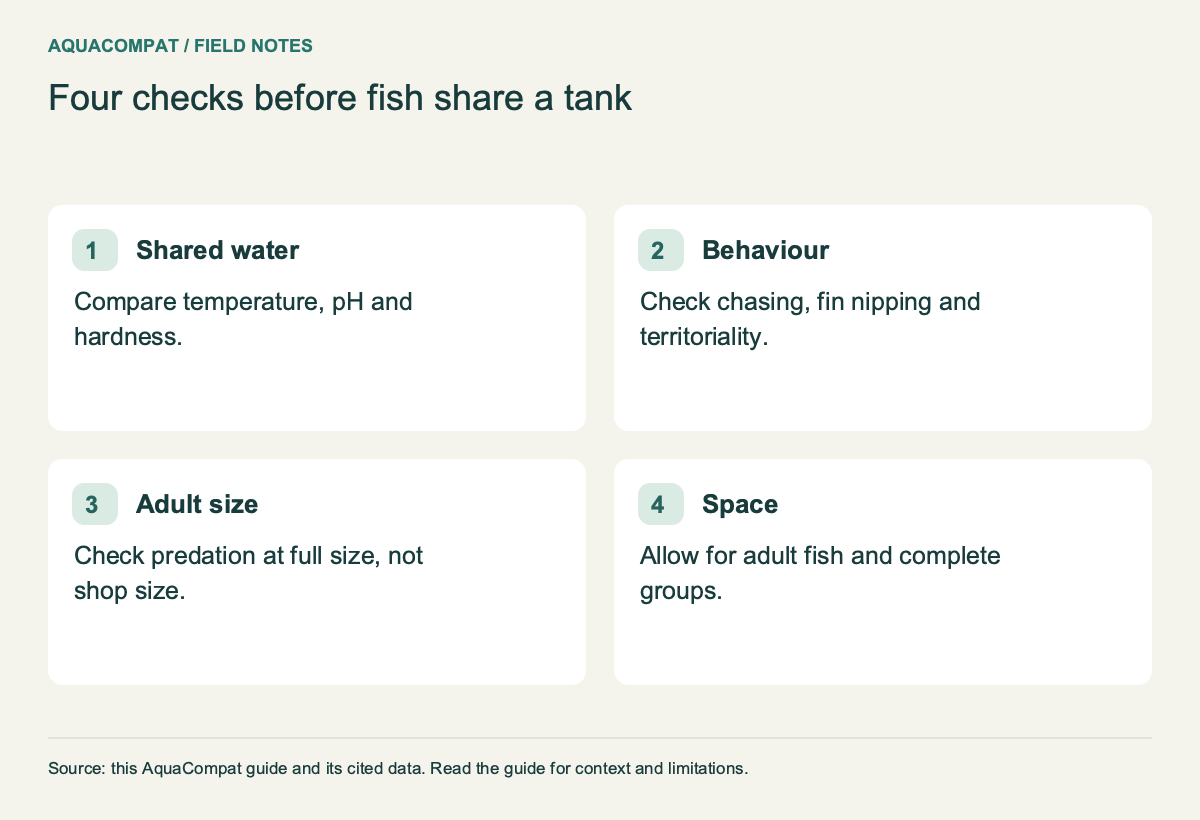
Aquarium fish compatibility is decided by four things: shared water, temperament, adult size and space. A pairing that fails any one of them fails as a whole, however well the other three line up. This is why a simple "peaceful" or "community fish" label in a shop is not enough on its own.
The four conditions work like this:
- Shared water. Both species need a temperature, pH and hardness range that overlaps. A goldfish kept at 59–70 °F (15–21 °C) and a betta fish that needs 72–86 °F (22–30 °C) have no temperature in common at all, so one of them is always outside its range.
- Temperament. A fish that chases, nips or fights will stress a calm tank mate even when the water suits both. Male bettas, for example, may attack long-finned fish they mistake for rivals, according to Seriously Fish.
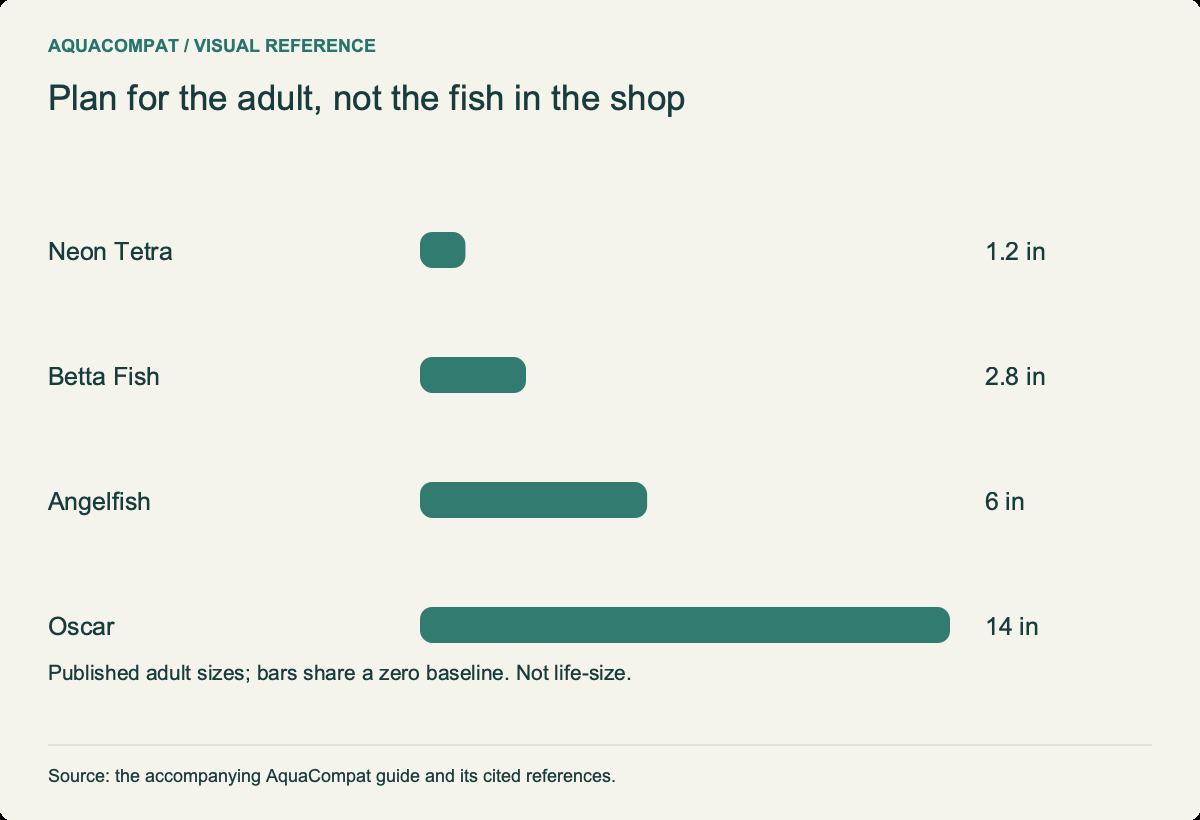
- Adult size and predation. Fish eat what fits in their mouths. An angelfish grows to 6 in (15.2 cm), and a neon tetra reaches only 1.2 in (3 cm), so the tetra is food once the angelfish is grown.
- Space. The tank has to suit the larger species' minimum and leave room for every school at its proper size.
Swim level matters too, but less: two species that use different layers of the tank compete less for room, while two bottom dwellers share one floor.
How does AquaCompat turn published data into a verdict?
AquaCompat turns published data into a verdict by applying one fixed formula to the two species' fact files. A fact file is the structured record for one species: its temperature, pH and hardness ranges, adult size, minimum tank, school size, temperament and diet, each value tied to the sources it came from. The formula weighs six factors, temperature overlap, temperament, size and predation risk, pH overlap, hardness overlap and swim level, and returns a score from 1 to 10.
A score of 8 or more reads as compatible, 5 to 7 as caution and below 5 as incompatible. Some problems override the score completely. If two species share no temperature range, or one eats fish the size of the other, the pair is marked incompatible whatever the arithmetic says. The full weighting, the list of deal-breakers and the method's limits are set out on the methodology page, so any verdict on the site can be traced back to its inputs.
Nothing on AquaCompat comes from our own tanks. The site compares published aquarium-care data from sources including Seriously Fish, FishBase, Aquarium Co-Op and Practical Fishkeeping, and where those sources disagree, the conflict is noted on the species page rather than hidden. The ranges used are aquarium-care ranges for farmed fish, which are usually wider than the water in the species' wild habitat.
Beyond single pairs, the free aquarium tools check a whole stocking list, the tank setups by size work through complete stocking plans, and the side-by-side species comparisons help when two similar species compete for the same spot. Who writes the site and how it is funded is explained on the about page.
Which fish pairs do people ask about most?
The pairs below are the ones searched most often in the US, ranked by search demand, with the verdict, score and shared temperature taken straight from the pair matrix. Each links to a full compatibility guide where one exists.
| Pair | Verdict | Score | Shared temperature |
|---|---|---|---|
| Betta fish and guppy | caution | 7/10 | 72–82 °F (22–28 °C) |
| Betta fish and goldfish | incompatible | 3/10 | no overlap |
| Guppy and molly | compatible | 9/10 | 70–82 °F (21–28 °C) |
| Betta fish and neon tetra | caution | 7/10 | 72–77 °F (22–25 °C) |
| Goldfish and guppy | incompatible | 3/10 | 68–70 °F (20–21 °C) |
| Betta fish and cherry shrimp | caution | 7/10 | 72–79 °F (22–26 °C) |
| Molly and platy | compatible | 8/10 | 70–77 °F (21–25 °C) |
| Betta fish and mystery snail | caution | 7/10 | 72–78 °F (22–26 °C) |
| Angelfish and discus | compatible | 8/10 | 79–86 °F (26–30 °C) |
| Angelfish and guppy | incompatible | 3/10 | 75–82 °F (24–28 °C) |
| Guppy and platy | compatible | 10/10 | 68–77 °F (20–25 °C) |
| Angelfish and betta fish | caution | 7/10 | 75–86 °F (24–30 °C) |
| Betta fish and bristlenose pleco | caution | 7/10 | 72–79 °F (22–26 °C) |
| Guppy and neon tetra | compatible | 8/10 | 70–77 °F (21–25 °C) |
Why do some popular pairs fail?
Popular pairs fail for three repeating reasons: temperature, predation and temperament. Each of the incompatible results in the table above traces back to one of them.
Temperature: goldfish with tropical fish
Goldfish are the clearest temperature mismatch. Their aquarium-care range of 59–70 °F (15–21 °C) does not reach the betta's at all, and against the guppy's 68–82 °F (20–28 °C) the shared band is only 68–70 °F (20–21 °C), too narrow to hold steadily in a home tank. Goldfish also grow to 10 in (25.4 cm), large enough to swallow small tropical fish.
Predation: angelfish with small fish
Angelfish share water well with guppies, but an adult angelfish eats fish small enough to swallow, and a guppy at 2.4 in (6.1 cm) qualifies. The same applies to neon tetras. The size factor is judged at adult size, so a verdict stays incompatible even while both fish are still small.
Temperament: bettas and long fins
Betta fish with guppies scores caution rather than incompatible. The water overlaps well across 72–82 °F (22–28 °C), but male bettas may treat a long-finned male guppy as a rival. Whether it works depends on the individual betta, the tank size and how much cover the guppies have, which is exactly what a caution verdict is meant to flag.
Which species does AquaCompat cover?
AquaCompat covers 22 freshwater species chosen because they are the fish, shrimp and snails most often kept together in home community tanks. They range from the 1.5 in (3.8 cm) Cherry Shrimp to the Oscar, which reaches 14 in (35.6 cm), and from coldwater goldfish to discus that need 79–86 °F (26–30 °C). Each species has its own care data, and the freshwater aquarium species index lists all 22 side by side with their temperature, pH, adult size and minimum tank.
Covering a fixed set of species keeps the pair matrix complete: every species has a scored verdict against every other, so a tank mates list never leaves out a common candidate. The trade-off is that fish outside the 22, such as rarer tetras or dwarf cichlids, do not yet have verdicts.
Most fish of these kinds reach shops from farms rather than the wild. A 2019 Journal of Fish Biology review estimates that 90 % of ornamental fish trade volume is tropical freshwater fish and that about 90 % of those are captive bred, figures drawn from a 2013 trade analysis. The USDA 2023 Census of Aquaculture counted 70.4 million freshwater egg-layers and 23.4 million livebearers sold by US farms that year, most of them from Florida.
Tank mates by species
- Betta fish tank matesPeaceful, short-finned species that tolerate a betta's warm water and temperament
- Guppy tank matesLivebearers and peaceful fish for harder, alkaline water
- Corydoras tank matesMidwater schools that leave the bottom to the catfish
- Cherry shrimp tank matesFish and snails small enough not to eat shrimp or shrimplets
- Angelfish tank matesSpecies too large to be eaten and calm enough not to nip
- Discus tank matesThe few community fish that tolerate discus temperatures
- Oscar tank matesLarge, robust fish for big cichlid tanks
- Goldfish tank matesColdwater-tolerant companions and the tropical fish to avoid
- Bristlenose pleco tank matesCommunity fish that share water with an algae-grazing catfish
- Kuhli loach tank matesGentle species for soft, acidic water
- Aquarium snail tank matesFish that leave nerite and mystery snails alone
- African cichlid tank matesCompanions for hard-water African cichlid tanks
What should you do before adding any fish?
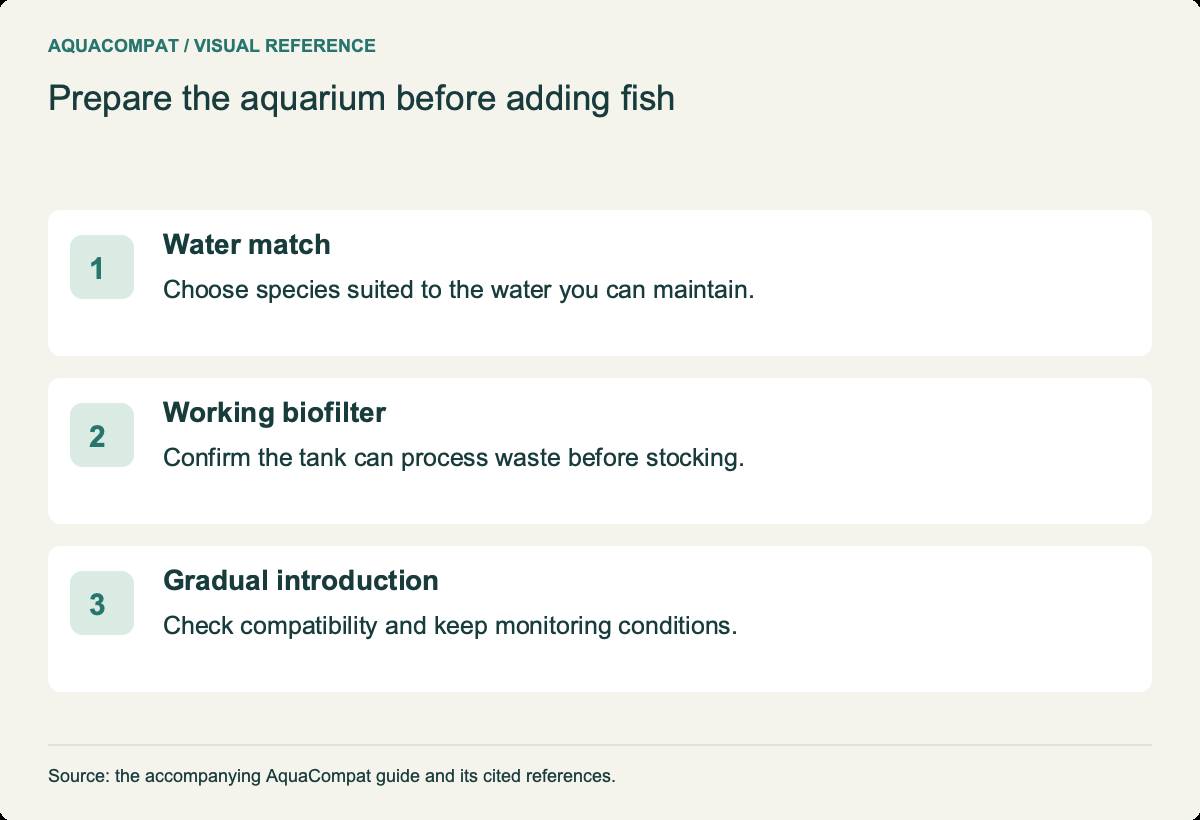
Before adding any fish, cycle the tank so that bacteria are in place to process fish waste. The nitrogen cycle is the process in which bacteria convert toxic ammonia from waste into nitrite and then into the far less harmful nitrate. A new tank has none of those bacteria, and fish added too early sit in rising ammonia, the problem known as new tank syndrome.
The guides below cover the setup order: how the cycle works, how to complete it without fish, and what a first small community tank can hold. Compatibility verdicts assume a cycled, stable tank; no pairing is safe in water that is still cycling.
Start-here guides
- The nitrogen cycle explainedAmmonia, nitrite and nitrate, and why a new tank needs weeks before fish
- Fishless cycling, step by stepCycling a new aquarium with an ammonia source instead of fish
- Stocking a 10-gallon community tankWhich of the 22 species fit a small first tank, and in what numbers
- New tank syndromeWhat happens when fish go in before the cycle is complete
- Aquarium temperature by speciesWhere each species sits on the tropical and coldwater scale
- Aquarium pH by speciesSoft-water and hard-water fish, and how to change pH gradually
Which equipment affects compatibility?
Heaters, filters and test kits affect compatibility more than any other equipment, because they decide whether the tank actually stays inside the shared range. A pair that overlaps by only a few degrees, such as Cardinal Tetra and Neon Tetra at 73–77 °F (23–25 °C), needs a heater that holds temperature closely. Fish with very different flow preferences need a filter that can be baffled or sized down, and a test kit is the only way to know the pH and hardness you are working with.
The equipment guides compare products on their published specifications, matched to tank size, rather than on ratings.
Equipment guides
- Aquarium heaters by tank sizeWattage and control type for holding a shared temperature range
- Canister filters by tank sizeHigh-capacity filtration for larger community and cichlid tanks
- Sponge filtersLow-flow filtration that suits shrimp, fry and bettas
- Aquarium test kits comparedMeasuring ammonia, nitrite, nitrate, pH and hardness
- Water conditioners comparedRemoving chlorine and chloramine from tap water
How are the species grouped?
The species are grouped by family and lifestyle, because fish in the same group tend to share water preferences and behaviour. Tetras are small schooling fish from soft South American water. Livebearers such as guppies, platies and mollies prefer harder, more alkaline water. Cichlids range from the peaceful discus to the large, predatory oscar. Catfish and bottom dwellers work the substrate, and shrimp and snails form the clean-up crew that many fish see as food. Each group page compares its members and lists the tank mates that suit the group as a whole.
Species groups
Is a "community fish" label enough to go on?
No, a "community fish" label is not enough, because it describes temperament only and says nothing about water or size. Neon tetras and discus are both described as peaceful, yet they share no temperature range: neons are kept at 70–77 °F (21–25 °C) and discus at 79–86 °F (26–30 °C). The pair is incompatible before temperament is even considered.
Size is the other common trap. A fish in a shop tank is rarely full grown, so compatibility should be judged on adult size, which is the figure every species page and verdict on this site uses. An Oscar sold at a few inches still grows to 14 in (35.6 cm) and needs at least 75 US gal (284 L).
The opposite case also exists. Some pairs that sound risky score well: a betta with a bristlenose pleco scores 7 out of 10, because the pleco lives on the bottom, is peaceful and shares the betta's water across 72–79 °F (22–26 °C).
What can a compatibility verdict not tell you?
A compatibility verdict cannot predict how one individual fish will behave. It is built from published species-level data, so it describes the typical case: a betta that ignores shrimp, or a tetra school that never nips, are both possible outside the averages. Treat compatible as a strong starting point, caution as a pairing that needs space, cover and watching, and incompatible as one to avoid.
Verdicts also cover freshwater species only. Saltwater and reef fish, brackish species and pond stocking are outside the site's scope. Within freshwater, the verdicts assume a cycled tank, stable temperature and a stocking level the filter can handle; the aquarium stocking calculator checks that last point for a full list of fish.
Questions people ask
How many fish pairs does AquaCompat score?
How do I check a whole community, not just one pair?
Use the stocking calculator, which takes your tank volume and every species you plan to keep. It checks each species against the tank size and its minimum group, looks up every pair at once, and shows the temperature and pH range all of them share. The checker above stays the quickest way to look at one pair in detail.
Why do sources disagree on water ranges?
Does a caution verdict mean the fish will fight?
Are the verdicts based on keeping the fish?
Sources 64 documents from 19 publishers
- Applesnail.net (applesnail.net): “How to take care of apple snails”; “Quick guide”; “Pomacea diffusa”
- Aquarium Co-Op (aquariumcoop.com): “Care Guide for Fancy Goldfish”; “Freshwater Angelfish Care Guide”; “Betta Fish Care Guide”; “Guppy Care Guide”; “Goldfish Tank Mates”; “Care Guide for Mollies: Feeding, Breeding, and Tank Mates”; “Care Guide for Cherry Shrimp”; “Care Guide for Platy Fish: Feeding, Breeding, and Tank Mates”; “Care Guide for Mystery Snails”; “Discus Fish Care Guide”; “Care Guide for Plecostomus”; “Oscar Fish Care Guide”; “Care Guide for Cardinal Tetras”
- AquariumInfo.org (aquariuminfo.org): “Apple Snail”
- Dr Tim's Aquatics (manufacturer) (drtimsaquatics.com): “Fishless Cycling”
- FishBase (fishbase.se): “Paracheirodon innesi summary page”; “Betta splendens, Siamese fighting fish: species summary”; “Poecilia reticulata, Guppy: species summary”; “Carassius auratus, Goldfish: species summary”; “Xiphophorus maculatus, Southern platyfish: species summary”; “Symphysodon aequifasciatus, Blue discus: species summary”; “Astronotus ocellatus, Oscar: species summary”
- fishkeeping.co.uk (fishkeeping.co.uk): “Goldfish Size, Life Expectancy and Tank Recommendations”; “Keeping Goldfish - The Right Way”
- Journal of Fish Biology, Evers, Pinnegar and Taylor (Cefas and University of East Anglia) (ueaeprints.uea.ac.uk): “Where are they all from? – sources and sustainability in the ornamental freshwater fish trade”
- Maidenhead Aquatics (fishkeeper.co.uk species data sheet) (fishkeeper.co.uk): “Guppy data sheet”; “Molly data sheet”; “Neon Tetra data sheet”; “Platy data sheet”; “Angelfish data sheet”; “Discus data sheet”
- Merck Veterinary Manual (merckvetmanual.com): “Environmental Diseases of Aquatic Animals in Aquatic Systems, Francis-Floyd, Yanong and Petty”; “Management of Aquarium Fish, Petty, Francis-Floyd and Yanong”
- Ornamental Aquatic Trade Association (OATA) (ornamentalfish.org): “How to look after fancy goldfish”; “How to look after goldfish in an aquarium / fish tank”
- PlanetCatfish (via Internet Archive snapshot, 2025) (web.archive.org): “Ancistrus sp. (3) Common Bristlenose Catfish Cat-eLog data sheet”
- Practical Fishkeeping (practicalfishkeeping.co.uk): “Frequently asked questions on Neocaridina shrimps”; “Quick guide to livebearers”; “Bristlenose catfish: the hardworking Ancistrus”; “How to Cycle a Fish Tank: The Complete Guide”
- Seriously Fish (seriouslyfish.com): “Betta splendens”; “Pterophyllum scalare”; “Paracheirodon innesi (Neon Tetra)”; “Poecilia reticulata”; “Poecilia sphenops”; “Poecilia latipinna”; “Xiphophorus maculatus”; “Symphysodon aequifasciatus”; “Ancistrus sp. '3' (Common Bristlenose Catfish)”; “Astronotus ocellatus”; “Paracheirodon axelrodi (Cardinal Tetra)”
- Shrimp and Snail Breeder (aquariumbreeder.com): “Red Cherry Shrimp: detailed guide, care, diet and breeding”; “Cherry Shrimp in a Community Tank”
- Shrimp Science (shrimpscience.com): “Red Cherry Shrimp - Care Guide”; “General Hardness (GH) For Shrimp Tanks”
- Southern Regional Aquaculture Center (srac.msstate.edu): “How to Start a Biofilter, SRAC Publication No. 4502, DeLong and Losordo”; “Nitrite in Fish Ponds, SRAC Publication No. 462, Durborow, Crosby and Brunson”; “Recirculating Aquaculture Tank Production Systems: Management of Recirculating Systems, SRAC Publication No. 452”
- UF/IFAS EDIS (ask.ifas.ufl.edu): “Evolution, Culture, and Care for Betta splendens (FA212)”
- University of Florida IFAS Extension (EDIS) (ask.ifas.ufl.edu): “Ammonia in Aquatic Systems (FA16/FA031), Francis-Floyd, Watson, Petty and Pouder”
- USDA National Agricultural Statistics Service (data.nass.usda.gov): “2023 Census of Aquaculture, Volume 3, Special Studies, Part 2 (AC-22-SS-2)”
All sources accessed . Every number on this page comes from these documents.